Joseph Priestley

by Don Carter, member Thomas Paine UU Fellowship


Return to the Priestley Home Page
Return to the UUCSV Home Page


Index to Information in this Document


BRITISH RELIGIOUS SETTING

The Toleration Act was passed by the British Parliament in 1689. This act permitted other religious denominations, such as Puritans, Quakers, Baptists, Catholics, and Jews, to legally exist in England alongside the Church of England. However, these non-Anglican denominations, referred to as dissenters or nonconformists, could only refer to their meeting houses as chapels. The word "church" was reserved for the Church of England. Also, dissenters were not allowed to hold public office, serve in the armed forces or attend the universities.

Within the Anglican Communion there was also growing unrest over the parliamentary requirement that the Anglican clergy must "subscribe" to the doctrinal articles of the church, including the Athanasian doctrine of the Trinity. For nearly a century afterwards a growing controversy continued over that requirement. A climax was reached in 1771, when Parliament refused a petition to abolish the requirement of "subscription." This precipitated some of the non-subscribing clergy to withdraw from the church. One of these, Theophilus Lindsey, was the organizer of the first Unitarian congregation in England. Lindsey conducted his first service for a large congregation in an auction room on Essex Street, London, on April 14th, 1774. Among those in that first congregation were Benjamin Franklin and his friend, Joseph Priestley.

PRIESTLEY'S EARLY YEARS

Joseph Priestley was brilliant, multi-talented, and controversial. He was a scientist, author, linguist, teacher, cleric, and political activist. He was born near the city of Leeds in Yorkshire in 1733. He was the oldest of five children in a lower middle class family. After the death of his mother, Priestley's father struggled to keep the family together until Joseph was nine years old. Eventually, young Priestley was placed in the care of his Puritan aunt, Mrs. Sarah Keighley. Thus Joseph Priestley was raised as a Dissenter.

At the age of 19 years, just before he left home for the Nonconformist Academy at Daventry, Priestley sought membership in the church he had always attended with his aunt. A precursor of things to come became evident when the church elders refused him membership on the grounds that he did not appear to be quite orthodox. The nature of the dispute had to do with the doctrine of original sin.

Priestley's three years of accelerated study at the academy were happy ones where he found a liberal and inquiring atmosphere among his teachers and fellow students. After receiving an education in literature and natural philosophy, he entered the ministry at Needham Market, Suffolk at the age of 22.

MINISTER AND EDUCATOR

Priestley's ministry in Suffolk and subsequently in Nantwitch in Cheshire were troubled by his growing liberal religious views. At both places, he sought to supplement his dwindling income by starting a school. Priestley introduced science into the curriculum of his Cheshire school where he provided some laboratory equipment for his students.

In 1761 Priestley was appointed to the chair of Languages and Literature at the Warrington Academy, one of England's leading dissenting schools. While in this post, he persuaded Dr. Mathew Turner, a surgeon, to join the faculty and teach courses in anatomy and chemistry. Priestley's introduction to chemistry was the result of his voluntary assistance in Dr. Turner's classes.

During his six years at Warrington, Priestley earned considerable acclaim. His achievements in the field of education gained him recognition from the University of Edinburgh where he received an honorary Doctor of Laws degree. It was also during this period that he met and married Mary Wilkinson. She became his companion of thirty four years who strengthened him through the many trials that lay ahead.

SCIENTIST

Priestley's early studies in electricity convinced him that a chronicle of knowledge on the subject was required. Research into this subject through the Royal Society in London brought Priestley into contact with Benjamin Franklin. With Franklin's friendly encouragement and assistance, Priestley published "The History and Present State of Electricity with Original Experiments." This publication was so well received that Priestley was elected a fellow of the Royal Society.

MINISTER AT LEEDS

In 1767, Priestley returned to the ministry where he served a large congregation at the Mill Hill Chapel in Leeds. While in Leeds, he started his reasoned attack on Christian orthodoxy with the publication of "The Institutes of Natural and Revealed Religion." He also published a number of political tracts which were highly critical of the attitude of the British government towards its American colonies. These works placed him in disfavor with both the English church and governmental authorities.

COMPANION TO EARL OF SHELBURNE / OXYGEN

In 1773, Priestley resigned from his ministry in Leeds and became a literary companion and librarian to William Petty, the second Earl of Shelburne. This new position with Shelburne provided Priestley with more time and funds to pursue his scientific experiments. It was during this period that he conducted his famous experiments with gases which resulted in the discovery of oxygen. In 1774, Priestley accompanied Lord Shelburne on an extensive tour of Europe where he became acquainted with Robespier and the Jacobins. He became a supporter of the "Republican" movement in France as well as that in the American Colonies. These movements were seen as seditious to the British monarchy and therefore highly unpopular. In 1780, Priestley and Lord Shelburne amicably parted company. Priestley's political and liberal religious views were becoming an embarrassment to Lord Shelburne.

MINISTRY AT BIRMINGHAM

Priestley again entered the ministry in the city of Birmingham where he served the New Meeting Chapel. During this period, he accelerated his controversial political activities. It was also at this time that he published his "History of the Corruptions of Christianity." This work was banned in England and copies were publicly burned in Holland.

Priestley became ever more active with the Dissenters in their efforts to influence Parliament to repeal those laws which prevented Dissenters from holding civil or military appointments. It was in 1786 that Priestley published his inflammatory "An History of Early Opinions Concerning Jesus Christ." Leaders of the Church of England and Parliament were convinced that the very foundations of the Church were in danger.

CHURCH AND KING RIOTS

On July 14, 1791, a number of the Jacobin sympathizers planned a dinner party at a Birmingham hotel in honor of the second anniversary of Bastille Day. Some instigators, who had learned of this meeting, managed to incite a riotous mob which formed out in front of the hotel. Upon learning of the mob's presence, the Jacobins quietly left. When the mob learned that the Dissenters had slipped away, they proceeded with the cry of "Church and King" on their lips, to set fire to Priestley's New Meeting Chapel. The Old Meeting Chapel was torched as well. Next, Priestley's home, library, and laboratory were ransacked and burned to the ground. The Priestley family had been able to escape before the mob descended, since friends had previously given them warning. The Priestley's then moved to the village of Hackney near London where they remained until they left England.

ASSOCIATES

Joseph Priestley had become something of a social outcast from his friends in the Royal Society due to his liberal political and religious views. However, he became associated with the circle of Dissenter artists and writers who gathered around the liberal London publisher, Joseph Johnson. Among this circle were such people as William Blake, Thomas Paine, Samuel Taylor Coleridge, and Benjamin Franklin, who spent much time in London representing the interests of the new American Republic and the State of Pennsylvania. Joseph Johnson's Sunday afternoon dinner parties were attended by these liberal minded people who were just as likely to dissent with each other as they were to dissent with the establishment. Michael Payne likened the meeting of these minds to "where Emily Dickinson might sit down to explain the meaning of her poetry to Attila the Hun." It was also during this period that Priestley befriended the American Universalist missionary, Elhanan Winchester, who was founding the "Philadelphian Society" in London. These two men shared an optimistic view of the salvation of humankind.

AMERICA

The pressures of disfavor were particularly difficult on Priestley's sons. The eldest boy, Joseph Jr. departed for America in 1793 followed by the youngest son, Henry. The middle son, William fled the Reign of Terror in France, where he had been attending school, to join his two brothers in America. After arrival in America, Priestley's sons and close friend Thomas Cooper, along with others, planned for the settlement of freedom-loving Englishmen on some 300,000 acres along the Susquehanna River north of the small frontier community of Northumberland, Pennsylvania. It was in this area that Samuel Taylor Coleridge and Robert Southey dreamed and planned of "Pantisocracy," the idealized community for English lovers of liberty.

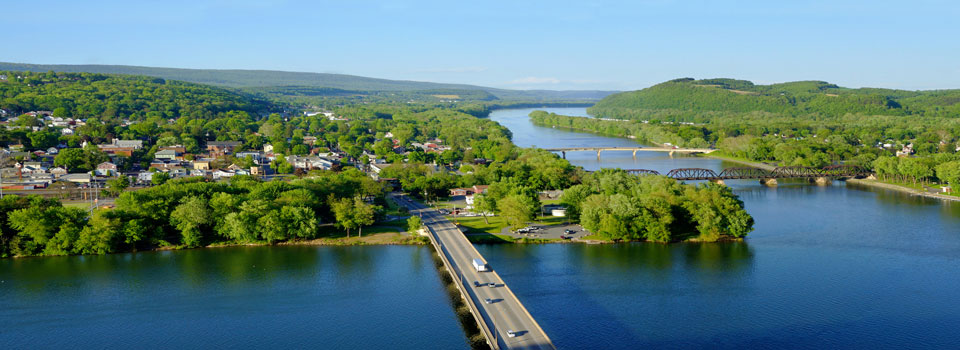
Finally, Priestley himself packed up his books and laboratory equipment and sailed from England in April of 1794. On arrival in the city of New York eight weeks later, the Priestleys were met by son Joseph Jr. and were welcomed by Governor George Clinton and the bishop of New York as well as by a number of learned societies and prominent citizens. After two weeks, they proceeded to Philadelphia, the nation's capital at that time. For three weeks the Priestleys were urged to settle in Philadelphia with its many political, scientific, religious, and social advantages. However, they moved on to the frontier community of Northumberland, 150 miles to the west, in order to be near their sons.

NORTHUMBERLAND, PENNSYLVANIA

The proposed community of freedom-loving English settlers never materialized and was finally abandoned. In spite of an offer of a professorship in chemistry at the University of Pennsylvania, Priestley decided to remain in Northumberland near his sons where he felt he would have more time to experiment and write. He also claimed that Philadelphia was too expensive. He bought land on the banks of the Susquehanna and started construction of his home and laboratory in the fall of 1794. Mary Priestley died in the summer of 1796, one year before the house was completed. Priestley wrote on that occasion, "This day I bury my wife. She died on Saturday after an illness of a fort-night. She had taken much thought in planning the new house and now that it is far advanced and promises to be everything she wished, she is removed to another."

PHILADELPHIA SERVICES

Priestley made the arduous trip from Northumberland to Philadelphia for a few weeks out of each year. While in the city, Elhanan Winchester, who had returned from England, invited Priestley to conduct religious services on Sunday afternoons. It was soon apparent that Priestley's morning services were drawing the elite of the new nation's capital. New friends, such as Thomas Jefferson, John Adams and those early Universalists, Benjamin Rush, and Benjamin Waterhouse, and many other notables. Old friend Ben Franklin would have most certainly been one of them had he not died a few years before. From this beginning, the first Unitarian Church in America emerged in the year of 1796. Joseph Priestley felt particularly close to Winchester and Rush because these men shared similar optimistic views of God's relationship with humankind. (Was Priestley really a Universalist?)

JEFFERSON AND PAINE

Priestley always remained on friendly terms with both Franklin and Jefferson although he often deplored their deistic views. Thomas Paine however, was a different matter. Since Priestley's published rebuttal of Paine's Age of Reason, he could never countenance the cantankerous Paine. His friendship with John Adams cooled somewhat when Priestley reluctantly became embroiled in the Federalist/Republican controversy.

Thomas Jefferson once wrote to Benjamin Waterhouse, "I trust there is not a young man now living who will not die a Unitarian." Although Jefferson remained a communicant of the Episcopalian Church throughout his life, his correspondence with Priestley, Rush, Waterhouse, and others certainly identify him as one of America's early Deists. In his later years, he wrote a new translation of the New Testament based upon the higher biblical criticism of the eighteenth century German scholars. In 1779, the year that John Murray founded the first Universalist church in Gloucester, Massachusetts, Jefferson composed a resolution for religious freedom for Virginia. The resolution provided for the elimination of the church tax which supported the Church of England in that state. The resolution was adopted in 1786 as the "Statute of Virginia for Religious Freedom."

LAST YEARS

Priestley spent the remainder of his life at his home in Northumberland near his sons and with his beloved laboratory and library. Since he was denied all pulpits in Northumberland, he conducted Unitarian services in his home every Sunday, wrote many scientific, philosophical and theological treatises, and corresponded with his many friends.

Priestley passed the last four years of his like as a semi-invalid and he died peacefully at home in 1804. He is best remembered today as the scientist who discovered oxygen, although he would surely prefer to be remembered as a Unitarian theologian and minister. He once characterized his own religious growth, starting with Calvinism in his youth, to high Arianism, to low Arianism, and finally to Socinianism. He also demonstrated a forgiving nature. After his escape from the rioting mob that had destroyed his home, valuable library, laboratory and church, he wrote a sermon and sent it to his congregation back in Birmingham for the next Sunday. The sermon was titled "Father, forgive them, for they know not what they do."

PRIESTLEY'S DEFENSE OF UNIVERSALISM

"The doctrine of eternal torments is altogether indefensible on any principles of justice or equity; for all the crimes of finite creatures being, of finite, cannot in equity deserve infinite punishment."

"Absurdity supported by power will never be able to stand its ground against the efforts of reason."